A new roof is one of the largest investments you will make in your home, and the contractor you choose matters as much as the shingles they install. The right roofer protects your home and your warranty for decades. The wrong one can leave you with leaks, denied insurance claims, and no one to call when problems show up two winters later.
Illinois takes this so seriously that it created a statewide roofing license specifically because storm-chasing fraud was so widespread, which makes it one of the few states where you can screen a roofer through a government database before you ever sign.
This guide walks you through exactly how to choose a roofing contractor, step by step, so you can hire with confidence and avoid the scams that follow every major storm.
Quick Answer: How to Choose a Roofing Contractor
To choose a roofing contractor, verify their license and insurance are in the company’s name, confirm they are an established local business with a physical location, ask whether their own employees or subcontractors will do the work, check their reviews across Google and Facebook, and compare detailed written estimates from two or three companies. Walk away from anyone who pressures you to sign on the spot or offers to waive your insurance deductible.
At a glance, a trustworthy roofing contractor should:
- Carry a valid roofing license and insurance listed in the company’s name
- Operate from a real, local, physical location
- Have several years of history under the same business name
- Use its own crews, or tell you plainly who the subcontractors are
- Have a findable website and genuine reviews on Google and Facebook
- Hold manufacturer certifications from the shingle brands they install
- Provide a detailed, itemized written estimate
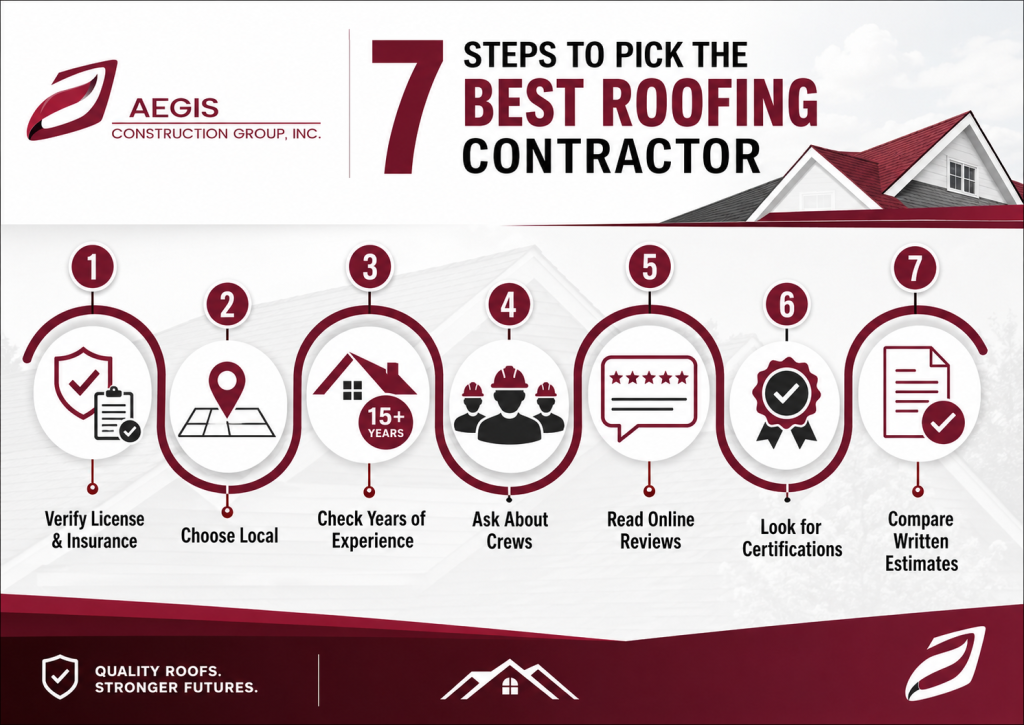
How to Choose a Roofing Contractor: 7 Steps to Vet Any Roofer
1. Confirm the license and insurance are in the company’s name
In Illinois, roofing is one of the trades that legally requires a state license. The Illinois Department of Financial and Professional Regulation (IDFPR) licenses all roofing and waterproofing work, and there is no legal way to roof a home in the state without one. There are two classes: a Limited license covers residential buildings of eight units or fewer, while an Unlimited license covers residential, commercial, and industrial properties. Either class is valid for a typical home, but a full-service company holding an Unlimited license signals a larger, more established operation.
The detail most homeowners miss is whose name the license and insurance are in. A license tied to a salesperson, or an insurance policy under a different entity, does not protect you if that specific company damages your home or walks off the job.
Here is how to verify it in Illinois:
- Look up the license on the IDFPR license portal at idfpr.illinois.gov and confirm it is active.
- Check that the license number and business name match the exact company on your contract, not an individual or a separate LLC.
- Ask for a certificate of insurance and confirm the roofer carries valid workers’ compensation, which Illinois requires. Without it, you can be held liable if a worker is injured on your property.
2. Hire a local roofing contractor with a physical location
Choose a roofer with a real, verifiable local presence. A brick-and-mortar office or showroom is a strong sign the company is established and will still be around if you need warranty work in five years. Local contractors also understand Chicagoland weather, local building codes, and each suburb’s permit process, which out-of-town storm crews rarely do.
Look up the company’s address and confirm it is an actual office or shop, not a PO box or a home address used only for business registration. Many storm-chasers register a local-sounding address to appear established when they have no real footprint in the area. Remember that Illinois law requires a licensed roofer’s physical street address to appear on their contracts, so a missing or vague address is both a local-presence red flag and a possible licensing violation.
When you can, visit the showroom in person. A place you can walk into is the clearest proof that a contractor is genuinely part of the community, not just passing through after a storm.
3. Check how many years they’ve been roofing
Ask how long the company has been performing roofing work under its current name. Longevity signals stability and accountability. Many roofing companies appear suddenly after a major storm to chase the money that insurance payouts provide, then disappear once the claims slow down, leaving homeowners with no one to honor the workmanship warranty.
Look for at least five to ten years of continuous local operation. Cross-check the founding date on the company’s website against its Google Business Profile, its Better Business Bureau profile, and its Illinois Secretary of State business registration. If those dates do not line up, ask why. A company that has weathered several Chicago winters has a local reputation worth protecting.
4. Ask whether in-house crews or subcontractors do the work
Ask a direct question: Will your own employees perform the work, or will it be subcontracted to another crew? This is the question almost no homeowner thinks to ask, and it separates accountable companies from the rest.
In-house crews mean the company that sold you the job is the same one responsible for its quality. Subcontracted work can lead to inconsistent workmanship, communication gaps, and finger-pointing over warranty claims if the subcontractor and the contractor blame each other later. When one company owns the entire process, from the first inspection to the final magnetic nail sweep, accountability never gets handed off. Ask who will be on site, whether they are the company’s own employees, and who is responsible if something goes wrong.
Aegis Construction Group uses its own in-house crews on every project, never subcontractors. Our teams are Aegis employees, backed by ongoing weekly and annual training, so the same standards and the same accountability carry through from your estimate to your completed roof.
5. Research their website, Facebook, and Google reviews
Before you call, look the company up across its website, Facebook page, and Google reviews. A legitimate, established roofer has a findable online footprint. If you cannot find the company online at all, that is a major red flag and usually a sign of a fly-by-night operation.
Read reviews for patterns rather than star ratings alone. Detailed reviews that mention specific crews, timelines, and how the company handled a problem are far more telling than a wall of one-line five-star ratings. Be skeptical of a sudden burst of perfect reviews with no detail, which can signal purchased or fake reviews.
6. Look for manufacturer certifications (GAF, Owens Corning, CertainTeed)
Look for certifications from the shingle manufacturers themselves. Credentials like GAF Master Elite, Owens Corning Platinum Preferred, and CertainTeed SELECT ShingleMaster are earned, not bought. Manufacturers require training, a proven track record, and proof of proper licensing and insurance before granting them, and they typically limit these designations to a small percentage of contractors.
Certified installers can also offer stronger, longer manufacturer warranties that non-certified roofers simply cannot provide. Ask which manufacturers certify the contractor, then verify it directly on the manufacturer’s website.
7. Compare detailed written estimates
Get detailed written estimates from at least two or three contractors, then compare what is included. A vague one-line quote hides where corners will be cut. A thorough, itemized estimate signals a contractor who measured carefully and stands behind the scope of work.
A complete roofing estimate should include:
- Tear-off and disposal of the old roofing
- Underlayment and ice-and-water barrier
- Flashing and ventilation work
- Materials, including manufacturer, product line, and color
- Who pulls the permit
- Project timeline with start and completion dates
- Payment schedule
- Workmanship and manufacturer warranty terms
- Cleanup, including a magnetic nail sweep of your property
The lowest bid is rarely the best value. A price well below the others usually means thinner materials, skipped steps, or an uninsured crew.
Know Your Roofing Warranty: Workmanship vs. Manufacturer
Every quality roof comes with two separate warranties, and homeowners often confuse them.
The workmanship warranty covers installation errors and is backed by the contractor, which is exactly why the contractor’s stability and years in business matter so much. If they go out of business, the workmanship warranty goes with them.
The manufacturer warranty covers defects in the roofing materials themselves and is backed by the shingle maker. Certified contractors can often register you for enhanced manufacturer coverage that standard installers cannot.
Ask how long each warranty lasts, whether the coverage is transferable if you sell the home, and what actions void it. Improper installation, unpermitted work, and later roof modifications by another company are common ways coverage gets voided.
Aegis Construction Group backs every residential roof with a 10-year workmanship warranty. If an issue ever arises from our installation, we repair the interior and exterior damage at no cost during the warranty period. As a GAF Master Elite contractor, a designation held by less than 2% of roofers nationwide, Aegis can also register homeowners for enhanced GAF manufacturer coverage that standard installers cannot access.
What To Know Before Filing a Storm Damage Insurance Claim
If storm, wind, or hail damage is involved, understand how the insurance process works before you sign anything.
A reputable contractor will inspect and document the damage with photos, meet your insurance adjuster on site, and prepare a supplement if the adjuster overlooks covered items. You, the homeowner, file the claim with your insurer. The contractor supports the process but does not replace you in it.
In many states, it is illegal for a contractor to pay, waive, rebate, or otherwise absorb your insurance deductible, and doing so can be treated as insurance fraud that puts you at risk as well. Any contractor who offers to make your deductible disappear is telling you they are willing to break the law, so walk away.
Be cautious with contracts that grant a contractor authority to deal directly with your insurer on your behalf, often called an assignment of benefits. Understand exactly what you are signing before you agree to it.
Roofing Contractor Red Flags to Avoid
Every point above has an opposite. Here is how a trustworthy contractor compares to one you should avoid.
| What to check | Trustworthy contractor | Walk away if |
|---|---|---|
| License & insurance | Active IDFPR license and certificate of insurance in the company’s exact legal name | License in a salesperson’s name, or “licensed” with no number to verify |
| Location | An office or showroom you can visit | PO box, out-of-state address, or a truck with no local footprint |
| Track record | Five to ten or more years under one business name | A brand-new company that appeared right after a storm |
| Who does the work | In-house employees | Subcontractors they will not name |
| Online presence | Website plus detailed Google and Facebook reviews | No footprint, or a sudden burst of generic five-star reviews |
| Certifications | GAF, Owens Corning, or CertainTeed, verifiable on the manufacturer’s site | Claims certifications that cannot be verified |
| Estimate | Itemized written scope of work | A one-line verbal quote |
| Your deductible | Explains that you are responsible for your deductible | Offers to waive, absorb, or “make your deductible disappear” |
| Timeline pressure | “Take the time you need to decide” | “Sign today or the price goes up” |
| Payment | Reasonable deposit and a milestone schedule | A large cash payment demanded up front |
The single most common thread among roofing scams is urgency. If a contractor is rushing you, that alone is reason enough to slow down.
Questions to Ask Before You Sign the Contract
Bring this list to every estimate. Each question has a reason behind it.
- Are your license and insurance in your company’s name? Protects you if this specific company causes damage.
- Are you licensed and insured in Illinois? Coverage has to match where the work happens.
- Will your own employees or subcontractors do the work? Accountability and consistent quality.
- How many years have you been roofing under this name? Filters out storm-chasers.
- Which manufacturers certify you? Certifications unlock stronger warranties.
- What does your workmanship warranty cover, and for how long? This is your protection against installation errors.
- Will you pull the permit? Unpermitted work can void warranties and complicate a future home sale.
- Can I see the full scope and estimate in writing? Prevents surprise charges and corner cutting.
- What is the payment schedule? Reasonable deposits, never a large cash payment up front.
- How do you handle cleanup and nail removal? Protects your yard, pets, and tires.
- Can you share local references or recent project addresses? A verifiable local track record.
Why Choose Aegis Construction Group for Your Chicagoland Roof
Everything above is exactly how we would want you to vet any roofer, including us. Here is how Aegis Construction Group measures up against that same checklist:
- Licensed, bonded, and insured under our own name: Aegis Construction Group, Inc. is fully licensed in Illinois (IL-LIC #104.017330) and Wisconsin (WI-LIC #032.200367), so the company on your contract is the company that carries the coverage.
- A local company with real showrooms you can visit: We serve Chicagoland from our main office and showroom in Villa Park, an Elmhurst location, and a Madison, WI office, not a PO box or a truck that leaves after storm season.
- A proven local track record since 2015: We have held a Complaint-Free A+ record with the Better Business Bureau since 2016 and were ranked a Top 3 Residential Roofing Contractor in Illinois.
- A trained, in-house Aegis team: Our crews are backed by ongoing weekly and annual training, so the quality stays consistent from the first inspection to the final nail sweep.
- Manufacturer certifications that unlock stronger warranties: Aegis is a GAF Master Elite contractor, an Owens Corning Preferred Contractor, and a CertainTeed SELECT ShingleMaster, credentials held by only a small fraction of roofers.
- A reputation you can verify online: Read our reviews across Google, Facebook, and Nextdoor, where we were voted a 2025 Neighborhood Favorite.
- A 10-year workmanship warranty on every residential roof: If an issue ever arises from our installation, we repair the interior and exterior damage at no cost during the warranty period.
We also specialize in guiding homeowners through the storm damage insurance claims process, from inspection to the adjuster meeting, and we offer flexible financing with rates as low as 0% for projects handled without a claim.
Ready to see where your roof stands? Schedule your free, no-pressure inspection with Aegis Construction Group today, or call (773) 812-3447.
Frequently Asked Questions
How do I check if a roofing contractor is licensed?
Ask for the license number and verify it through your state or local licensing board’s online lookup. Confirm the license is active and listed in the same business name that appears on your contract.
How many estimates should I get for a new roof?
Get at least two or three itemized written estimates so you can compare scope, materials, and warranty coverage, not just price. The lowest bid often means skipped steps or cheaper materials.
What is the difference between a workmanship warranty and a manufacturer warranty?
A workmanship warranty covers installation errors and is backed by the contractor. A manufacturer warranty covers defects in the roofing materials and is backed by the shingle maker. You want both.
Are roofing contractors who offer to waive your deductible legitimate?
No. In many states, waiving or absorbing a homeowner’s insurance deductible is illegal and can constitute insurance fraud. Treat the offer as a warning sign and choose another contractor.
How long does a roof replacement take?
Most residential roof replacements take 1-3 depending on the size of the roof, the materials, and the weather.
How do I avoid roofing storm chasers?
Hire local. Storm chasers are out-of-town crews who appear after a storm, pressure you to sign quickly, and disappear after they are paid. A local contractor with a physical address, a history in your community, and real online reviews is your best protection.