Poor attic ventilation can damage your roof by allowing excessive heat and moisture to build up beneath the roof deck. Over time, these conditions can contribute to premature shingle deterioration, condensation, warped or rotted roof decking, mold growth, corroded fasteners, damp insulation, and ice dams.
In Chicago and throughout Chicagoland, proper attic ventilation is especially important because roofs must withstand hot summers, freezing winters, snow, and repeated freeze-thaw cycles. However, ventilation is only one part of the equation. Proper attic insulation and air sealing are also important for controlling heat and moisture.
Quick Answer: How Does Poor Attic Ventilation Damage a Roof?
Poor attic ventilation can damage a roof by trapping heat and moisture in the attic instead of allowing them to escape. The resulting conditions can:
- Accelerate asphalt shingle deterioration
- Cause condensation on the underside of the roof deck
- Contribute to wood rot and weakened roof decking
- Encourage mold and mildew growth
- Corrode roofing nails and other metal components
- Reduce the effectiveness of damp insulation
- Contribute to uneven snowmelt and ice dams
- Increase the risk of moisture intrusion and roof leaks
- Shorten the service life of roofing materials
A properly designed attic ventilation system allows fresh outdoor air to enter through low intake vents, such as soffit vents, while hot and moist air exits through higher exhaust vents, such as ridge vents. Ventilation should work together with adequate insulation and air sealing to control heat and moisture in the attic.
How Does Poor Attic Ventilation Damage a Roof?
An under-ventilated attic can become a heat and moisture trap. Over time, those conditions can affect nearly every component of the roof assembly.
If these problems are already present, a professional roof inspection can help determine whether ventilation, moisture, insulation, or another roofing issue is contributing to the damage.
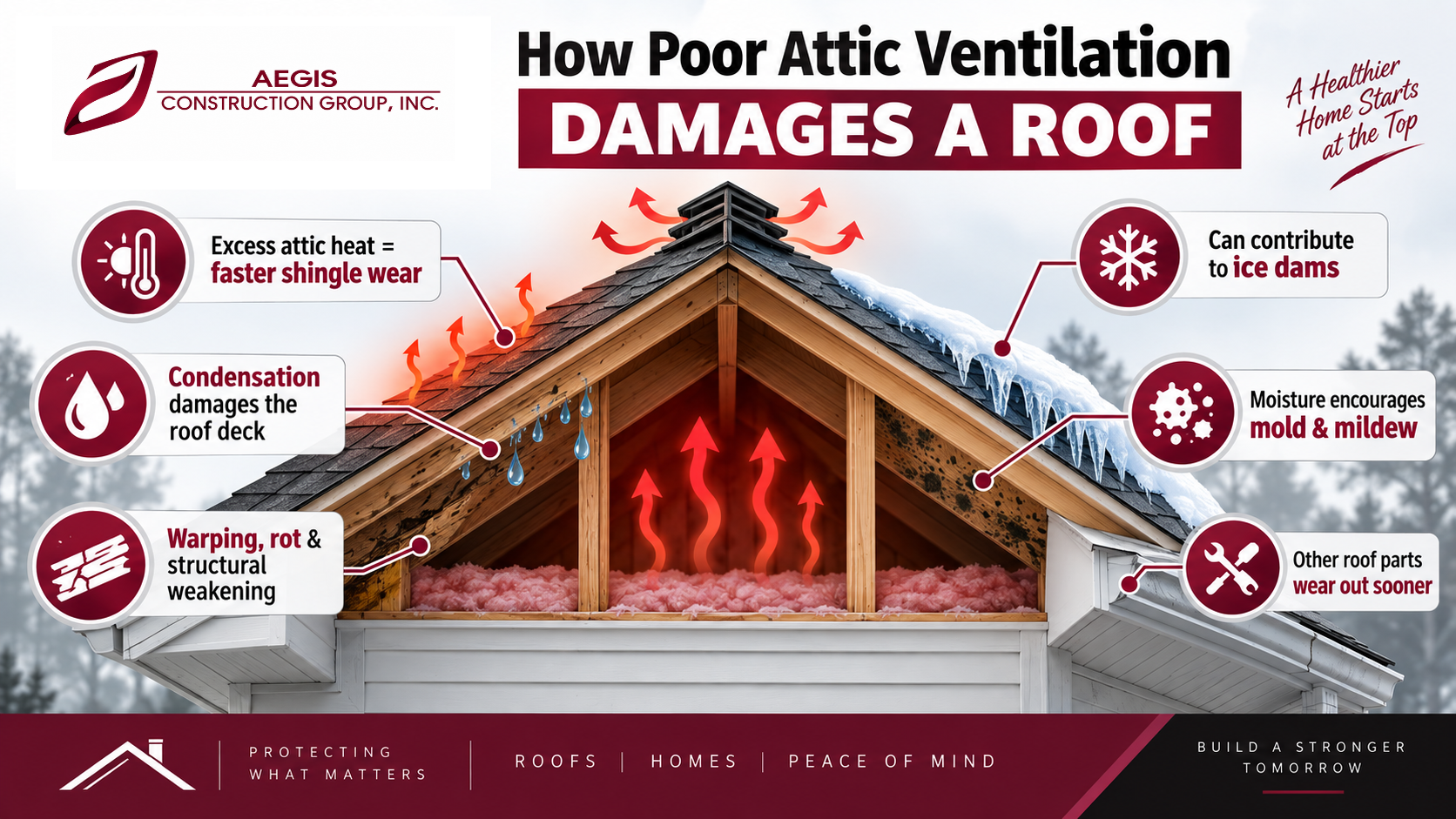
1. Excessive Attic Heat Can Accelerate Shingle Deterioration
During a hot summer afternoon, an attic with inadequate airflow can become significantly hotter than the outdoor air. Without an effective ventilation path, that heat can remain trapped beneath the roof deck.
Asphalt shingles are designed to withstand sunlight and heat, but prolonged exposure to excessive temperatures can accelerate aging. Over time, shingles may become brittle, lose granules, curl, crack, or otherwise deteriorate prematurely.
ENERGY STAR notes that natural airflow through a well-ventilated attic helps move super-heated air out of the attic during summer, helping protect roof shingles while also removing moisture.
Heat can also contribute to repeated expansion and contraction of roofing components. Over many seasons, this movement can place additional stress on fasteners, flashing, sealants, and other parts of the roofing system.
2. Moisture Can Cause Condensation and Roof Deck Damage
Moisture is one of the most damaging consequences of an attic that does not properly manage airflow.
During winter, warm, humid air from the living space can enter the attic through gaps around ceiling penetrations, attic hatches, recessed lights, plumbing penetrations, and other openings. When that warm air encounters cold roof sheathing, moisture can condense on the underside of the roof deck.
Common sources of moisture entering an attic include:
- Showers and baths
- Cooking and dishwashing
- Laundry
- Improperly vented clothes dryers
- Bathroom exhaust fans that terminate in the attic
- Kitchen exhaust fans that terminate in the attic
- Humidifiers and excessive indoor humidity
- Unsealed attic hatches
- Recessed lights and other ceiling penetrations
- Gaps around plumbing and electrical penetrations
If the moisture remains trapped, repeated condensation can contribute to staining, wood deterioration, mold growth, and other damage.
3. Roof Decking Can Warp, Rot, or Weaken
Roof decking provides the structural surface beneath the roofing materials. When it repeatedly absorbs moisture and dries out, the wood can swell and shrink.
Over time, this can contribute to:
- Warping
- Cupping
- Delamination
- Soft or weakened sheathing
- Wood rot
- Reduced fastener holding power
Severely deteriorated decking can also create an uneven surface beneath the shingles. Shingles that cannot lie flat may develop gaps or weak points where wind-driven rain can penetrate.
Once roof decking begins to deteriorate, the problem becomes more than a roofing-material issue. Damaged sheathing can affect the structural integrity of the roof assembly.
4. Poor Ventilation Can Contribute to Ice Dams
Ice dams are a significant concern for homeowners throughout Chicagoland. An ice dam forms when snow melts on warmer portions of a roof and then refreezes near the colder eaves. The resulting ice barrier can prevent meltwater from draining normally.
The process can look like this:
- Heat enters the attic from the living space.
- That heat warms portions of the roof deck.
- Snow melts over the warmer sections of the roof.
- Meltwater flows toward the colder eaves.
- The water refreezes near the roof edge.
- Ice accumulates and forms a dam.
- Additional meltwater backs up behind the dam.
- Water can work beneath shingles and into the roofing system.
Proper attic ventilation helps keep the roof deck closer to outdoor temperatures, which can reduce uneven snowmelt. However, ventilation alone is not a complete ice-dam solution.
Important: Attic ventilation, insulation, and air sealing work together. Adequate insulation and air sealing help prevent heat and moisture from the living space from entering the attic in the first place, while ventilation helps move heat and moisture out of the attic. ENERGY STAR recommends addressing these components together.
5. Moisture Can Lead to Mold and Mildew
Poor ventilation does not automatically cause mold. Instead, inadequate airflow can contribute to the elevated moisture conditions that allow mold and mildew to develop.
In a damp attic, mold may appear on:
- Roof sheathing
- Rafters and trusses
- Other wood framing
- Insulation
- Other organic materials
Damp insulation can also become compressed and lose some of its insulating effectiveness. If you notice mold, persistent moisture, or a musty odor in the attic, the goal should be to identify and correct the underlying moisture source rather than simply treating the visible mold.
6. Other Roof Components Can Deteriorate Prematurely
Shingles receive most of the attention, but excessive heat and moisture can affect other parts of the roofing system, including:
- Roof decking and sheathing
- Rafters and trusses
- Underlayment
- Attic insulation
- Roofing nails and fasteners
- Flashing
- Sealants around roof penetrations
- Sheathing around valleys and eaves
Rusted nail heads or other corroded metal components can be a visible indication that moisture has been affecting the attic for an extended period.
What Are the Signs of Poor Attic Ventilation?
Attic ventilation problems do not always announce themselves with an obvious roof leak. Some signs appear inside the attic, while others may show up as changes to the roof or home.
Common signs include:
- An attic that feels punishingly hot in summer, well beyond outdoor temperatures
- Visible condensation, water droplets, or damp surfaces in the attic
- Frost or ice crystals on the underside of the roof deck in winter
- Mold, mildew, or dark staining on sheathing and framing
- Damp, matted, or compressed insulation
- A musty or damp odor in the attic or upper floors
- Rusted or corroded roofing nails, fasteners, and metal connectors
- Warped, sagging, soft, or discolored roof decking
- Shingles that are curling, cracking, or losing granules ahead of schedule
- Recurring ice dams or icicles along the eaves and gutters
- Higher-than-expected indoor humidity, or upstairs rooms that stay hot
- Cooling costs that climb faster than the weather explains
One symptom does not necessarily prove that poor ventilation is the cause. However, multiple signs occurring together can indicate that the attic should be professionally evaluated.
What Causes Poor Attic Ventilation?
Poor attic ventilation is not always caused by a lack of vents. In many homes, the vents are present but the system cannot move air effectively.
Common causes include inadequate intake ventilation, insufficient exhaust ventilation, blocked soffit vents, insulation blocking airflow, improperly configured vents, and air leakage between the home and attic.
Not Enough Intake Ventilation
Intake vents allow fresh outdoor air to enter the attic. They are commonly located:
- In soffits
- Along eaves
- At the lower edge of the roof
Without adequate intake ventilation, exhaust vents may not have enough replacement air to move through the attic. This is why simply adding more exhaust vents does not necessarily solve an attic ventilation problem.
Not Enough Exhaust Ventilation
Exhaust vents allow hot and moist air to leave the attic. Common exhaust options include:
- Ridge vents
- Box or roof louvers
- Gable vents
- Wind turbines
- Powered attic ventilators
The appropriate system depends on the home’s roof design and ventilation configuration.
Blocked Soffit Vents
Soffit vents can become blocked by:
- Paint
- Dust and debris
- Bird nesting material
- Insects or nests
- Insulation
A soffit vent may look open from the ground while being blocked from the attic side.
Insulation Blocking Airflow
Adding insulation without maintaining an open path from the soffits can restrict intake airflow.
Rafter vents, also called insulation baffles or vent chutes, create a channel between the insulation and roof deck so outside air can move from the soffits into the attic. ENERGY STAR specifically recommends maintaining this airflow path when adding attic insulation.
An Imbalanced Ventilation System
A properly configured attic ventilation system provides a continuous airflow path from lower intake vents to higher exhaust vents. Problems can occur when incompatible or poorly positioned exhaust vents compete with one another.
For example, a ridge vent combined with certain gable-vent configurations may allow air to enter through the gable opening rather than traveling through the intended soffit-to-ridge pathway. The attic may appear to have plenty of vents while still having areas of stagnant airflow.
Powered Attic Fans Can Create Problems
Powered attic fans are not automatically the solution to a poorly ventilated attic. If intake ventilation is inadequate and the attic is not properly air-sealed from the living space, a powered fan can pull conditioned air from the home into the attic.
That can increase energy use and potentially introduce additional moisture into the attic. ENERGY STAR similarly cautions that attic fans can pull conditioned air from the house when soffit ventilation is blocked and the attic is not properly sealed.
Why Chicago Homes Are Especially Vulnerable to Attic Ventilation Problems
Chicago-area roofs experience significant seasonal temperature changes. A roof may experience:
- Hot summer temperatures
- Freezing winter conditions
- Snow accumulation
- Repeated freeze-thaw cycles
- Ice and snow at the roof edge
- Significant temperature differences between the living space and attic
Older homes can present additional challenges. Some may have limited soffit ventilation, outdated ventilation configurations, previous roofing modifications, or insulation that was installed without maintaining proper intake airflow.
Roof replacements and insulation projects can also change how an attic ventilation system functions. For these reasons, Chicago homeowners should look at the roof, ventilation, insulation, and air sealing as an interconnected system rather than treating each component separately.
What Does Proper Attic Ventilation Look Like?
A properly designed attic ventilation system generally allows fresh outdoor air to enter through lower intake vents and move upward toward higher exhaust vents.
The basic airflow path is: Outside air → soffit/eave intake → airflow along the roof deck → ridge or high exhaust → outside
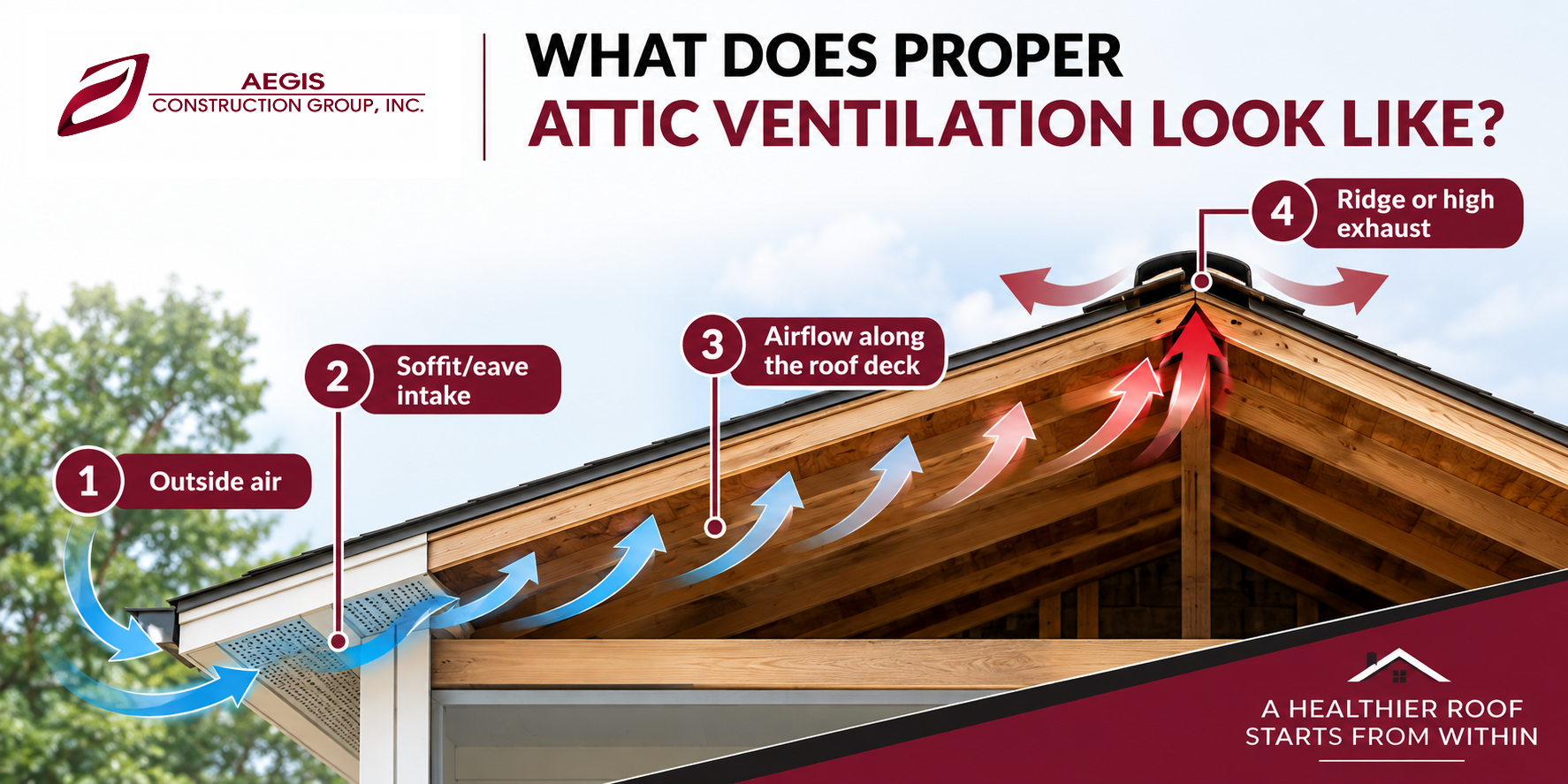
Intake vents
- Continuous or individual soffit vents
- Eave vents
- Edge or drip-edge intake vents, used where soffits are narrow or absent
Exhaust vents
- Ridge vents, which run along the peak and provide continuous exhaust
- Roof louvers, also called box vents
- Gable vents, in appropriate configurations
- Wind turbines
- Powered attic ventilators
Why Intake and Exhaust Need to be Balanced
A ridge vent cannot solve an attic ventilation problem by itself. A ridge vent needs adequate intake airflow because air must enter the attic before it can exit through the higher exhaust opening. A useful way to visualize this is:
Intake ventilation + clear airflow path + exhaust ventilation = effective attic ventilation
If the soffit vents are blocked, adding a ridge vent does not automatically create the airflow the attic needs.
How Much Attic Ventilation Does a Roof Need?
The amount of attic ventilation required depends on the size and configuration of the vented attic space, the ventilation system, applicable building code, and construction details. A commonly referenced calculation involves 1 square foot of net free ventilating area for every 150 square feet of vented attic space.
The 2021 International Residential Code also provides an exception allowing 1 square foot of net free ventilating area for every 300 square feet of vented space when specific conditions are met, including requirements related to vapor retarders and the distribution of upper and lower ventilation.
What Is Net Free Ventilating Area?
Net free ventilating area, or NFVA, refers to the actual open area through which air can pass. The physical size of a vent is not necessarily the same as its NFVA because screens, louvers, and other components reduce the open area. Vent manufacturers typically provide an NFVA rating for their products.
Why the 1:150 or 1:300 Ratio Is Only a Starting Point
A ventilation calculation should account for more than attic floor area. Factors can include:
- Roof design
- Attic configuration
- Roof pitch
- Climate
- Vapor retarder
- Intake and exhaust locations
- Type of ventilation products
- Roof geometry
- Applicable local building requirements
Complex roofs with multiple ridges, valleys, dormers, and hips may require a more detailed ventilation assessment. A roofing professional can evaluate the existing system and determine whether the intake and exhaust ventilation are appropriately sized and configured.
Can Poor Attic Ventilation Cause Roof Leaks?
Poor attic ventilation usually does not create a hole in the roof directly, but it can damage roofing materials and create conditions that increase the risk of water intrusion. Several ventilation-related problems can contribute to roof or ceiling moisture:
- Ice dams: Water backing up behind ice at the eaves can get under shingles and into the deck. This is the most common ventilation-related source of actual interior water damage in northern Illinois.
- Deteriorated shingles: Heat-aged shingles that curl, crack, or lose granules stop shedding water reliably.
- Damaged roof decking: Warped or rotted sheathing creates uneven surfaces and gaps and holds fasteners poorly.
- Condensation: Moisture forming on the underside of the deck can drip onto insulation and ceilings.
- Corroded fasteners: Rusted nails lose grip, allowing shingles to lift in wind.
- Failed flashings and sealants: Heat and moisture cycling degrade the details around penetrations, which is where a lot of real leaks begin.
If you have an unexplained water stain on an upper-floor ceiling, do not automatically assume that the roof has a hole. An attic inspection can help determine whether the moisture is coming from a roof leak, condensation, an ice dam, or another source.
Does Poor Attic Ventilation Shorten the Life of a Roof?
Yes. Inadequate attic ventilation can contribute to premature deterioration of roofing materials by allowing excessive heat and moisture to remain in the roof assembly. Think of the problem as three forces working against the roof over time:
- Heat can accelerate shingle aging.
- Moisture can damage wood, insulation, and metal components.
- Time allows repeated heat and moisture exposure to compound the damage.
The result can be a roof that deteriorates sooner than expected and requires repairs or replacement earlier than it otherwise might. The impact is not limited to the shingles. Damage to decking, insulation, fasteners, and other components can increase the scope and cost of a roofing project.
What Should You Not Do If Your Attic Has Poor Ventilation?
When homeowners discover an attic ventilation problem, the solution is not always to install more vents.
Don’t Simply Add Another Exhaust Vent
Adding more exhaust without adequate intake airflow may not correct the underlying problem.
Don’t Cover Soffit Vents With Insulation
Blocking soffit vents can restrict the intake airflow the ventilation system depends on. ENERGY STAR recommends using rafter vents or baffles to maintain a clear path from the soffits into the attic.
Don’t Assume a Ridge Vent Will Fix Everything
A ridge vent requires adequate intake ventilation to work as intended.
Don’t Ignore Air Leaks
Warm, moist air entering the attic through ceiling penetrations can contribute to condensation and moisture problems.
Don’t Assume Ventilation Is the Only Problem
A professional evaluation should consider ventilation, insulation, air sealing, moisture sources, and the condition of the roof assembly together.
How Can You Fix Poor Attic Ventilation?
Fixing poor attic ventilation starts with identifying why the existing system is not working.
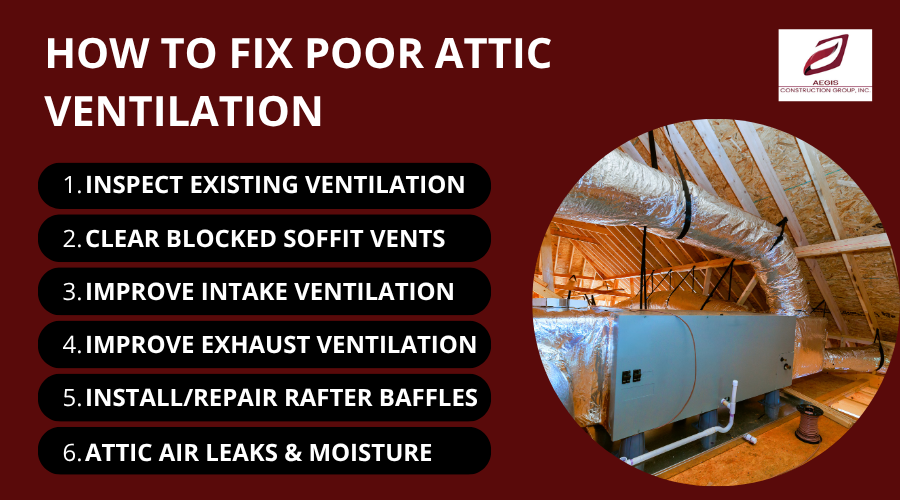
1. Inspect the Existing Ventilation
Evaluate:
- Intake vent locations
- Exhaust vent locations
- Vent types
- Net free ventilating area
- Blockages
- Airflow paths
- Condition of insulation
- Evidence of condensation or moisture
2. Clear Blocked Soffit Vents
Removing paint, debris, nesting material, or insulation that blocks intake vents can restore airflow.
3. Improve Intake Ventilation
Depending on the roof, solutions may include:
- Adding soffit vents
- Installing continuous soffit ventilation
- Improving eave intake
- Adding appropriate edge intake ventilation
4. Improve Exhaust Ventilation
Depending on the roof configuration, solutions may include:
- Installing or improving a ridge vent
- Adding appropriately sized roof louvers
- Reconfiguring existing exhaust vents
- Correcting improperly positioned ventilation
5. Install or Repair Rafter Baffles
Where insulation is blocking the intake path, baffles can create a clear channel between the soffit and attic.
6. Address Attic Air Leaks and Moisture Sources
Ventilation manages heat and moisture, but it does not eliminate the sources of those problems.
Potential improvements include:
- Redirecting bathroom exhaust fans outdoors
- Ensuring dryer vents terminate outdoors
- Sealing attic hatches
- Sealing ceiling penetrations
- Addressing gaps around plumbing and electrical penetrations
- Evaluating indoor humidity
- Improving attic insulation where appropriate
ENERGY STAR recommends addressing air leaks and insulation along with ventilation rather than treating ventilation as an isolated issue.
When Should You Have Your Roof and Attic Inspected?
Consider scheduling a roof and attic inspection if you notice:
- Curling, cracking, or premature shingle deterioration
- Excessive granule loss
- Mold or mildew in the attic
- Musty odors
- Frost on the underside of the roof deck
- Visible condensation
- Rusted roofing nails
- Damp insulation
- Warped, soft, or stained roof decking
- Recurring ice dams
- Heavy icicle formation
- An unusually hot attic
- Upper rooms that are difficult to cool
- Unexplained water stains on ceilings
- Roof materials deteriorating sooner than expected
An inspection can help determine whether the underlying issue involves ventilation, insulation, air leakage, a roof leak, condensation, or another problem.
For Chicago-area homes, it can be especially useful to evaluate the roof and attic after winter weather and before another season of snow and ice.
Get Your Attic Ventilation and Roof Evaluated by Aegis Construction Group
Attic ventilation is easy to ignore because the damage it causes develops slowly. But trapped heat, condensation, and repeated moisture exposure can turn a small ventilation issue into damaged shingles, rotted decking, mold, ice dams, and premature roof replacement. The sooner you identify the problem, the more options you have for fixing it before the damage spreads.
If you’re seeing signs of poor ventilation or simply aren’t sure whether your attic is working the way it should, Aegis Construction Group can assess the condition of your roof and attic and identify problems that aren’t always visible from the ground.
If the inspection finds damaged shingles, decking, flashing, or other roofing components, addressing them promptly can help prevent a minor issue from becoming a much larger repair. Learn more about roof repair services from Aegis Construction Group and take care of roofing problems before the next Chicago winter puts them to the test.
Call (773) 812-3447 or contact us online to schedule your free roof inspection.
Poor Attic Ventilation FAQs
How do I know if my attic has enough ventilation?
The most reliable answer comes from a professional assessment, but there are things you can check yourself. In summer, an attic that feels dramatically hotter than the outdoor air suggests trapped heat. In winter, look for frost or condensation on the underside of the roof deck. Also check whether your soffit vents are open, since paint, debris, and insulation frequently block them. A contractor will calculate your required net free ventilating area and compare it to what’s installed.
Can poor attic ventilation cause mold?
Poor ventilation doesn’t cause mold on its own, but it creates the moisture conditions that allow mold and mildew to grow. When humid air can’t escape the attic, it condenses on cool surfaces such as the roof deck and framing, and those damp organic materials are where mold develops. Fixing the ventilation and the moisture sources addresses the underlying condition.
Does attic ventilation help prevent ice dams?
It helps, but it usually isn’t a complete solution on its own. Balanced ventilation keeps the roof deck closer to the outside temperature, which reduces the uneven snowmelt that forms ice dams. Air sealing and adequate attic insulation are equally important, because they limit how much heat reaches the attic in the first place. The three work together.
How much attic ventilation does a roof need?
The commonly referenced guideline is 1 square foot of net free ventilating area for every 300 square feet of attic floor space, split between intake and exhaust. That ratio depends on conditions such as a vapor retarder at the ceiling or a balanced upper and lower vent split, and a more demanding ratio may apply otherwise. Roof design, attic volume, climate, vent type, and local code all affect the actual requirement, so it should be calculated for your specific roof.
Will adding a ridge vent fix my ventilation problem?
Not by itself. A ridge vent needs adequate intake ventilation at the soffits or eaves to work, because air has to enter the attic low in order to exit high. A ridge vent installed over blocked or insufficient soffit vents does very little and can even pull air from other exhaust openings or from the conditioned space below. Intake and exhaust must be sized and configured together.
Can poor attic ventilation increase my energy bills?
Yes. A superheated attic makes the upper floor of a home harder to cool, which increases air conditioning runtime in summer. Moisture is a factor too, because damp or compressed insulation loses R-value and performs worse in both seasons. Homeowners often notice cooling costs climbing before they notice anything wrong with the roof itself.
How often should I have my attic and roof inspected?
At least once a year is a good baseline in the Chicago area, ideally in spring after winter weather and again in fall before temperatures drop. You should also schedule an inspection after a major storm, or any time you notice signs of moisture, mold, ice dams, or unusual attic heat. Aegis Construction Group offers free roof inspections throughout Chicagoland.
Does poor ventilation void a shingle warranty?
It can affect coverage. Most shingle manufacturers specify minimum ventilation requirements as a condition of their warranties, and inadequate ventilation is a common reason a premature-failure claim gets questioned or denied. Check your specific warranty documentation, and have a contractor confirm your roof meets the manufacturer’s ventilation requirements.