Snow and ice damage a roof in three ways: the weight of built-up snow strains the structure, ice dams push meltwater under the shingles, and freeze-thaw cycles pry open small gaps. Chicagoland winters make all three worse because temperatures swing above and below freezing repeatedly, sometimes within a single day. Here is what to watch for, how to handle ice dams safely, and when to call a roofer.
Quick Takeaways: Snow, Ice Dams, and Your Roof
Most winter roof damage comes from water, not weight. Ice dams and freeze-thaw cycles cause more leaks than snow load does.
- Ice dams: Heat escaping from the attic melts snow that refreezes at the eaves and forces water under the shingles.
- Snow load: Wet snow and ice weigh several times more than fresh powder, so depth alone tells you little.
- Freeze-thaw cycles: Water expands about 9 percent as it freezes, widening small gaps around flashing and shingles.
- Early warning signs: Large icicles, ceiling stains, and frost in the attic.
- Urgent signs: Sagging, cracking sounds, and doors that suddenly stick.
- What to do: Rake snow from the ground, leave ice removal to a professional, and document damage before calling your insurer.
How Does Snow and Ice Damage a Roof?
Snow and ice damage a roof through weight, water, and expansion. Heavy, wet snow strains the framing, ice dams trap meltwater that leaks under shingles, and water freezing in small gaps widens them with every cycle. Each causes different warning signs, which tells you how urgent the repair is.
Snow Load and Weight
Roofs are built to carry snow, and most homes never get near their limit. Trouble starts when wet snow piles up, drifts against dormers and chimneys, or slides off an upper roof onto a porch or addition below.
What Is an Ice Dam?
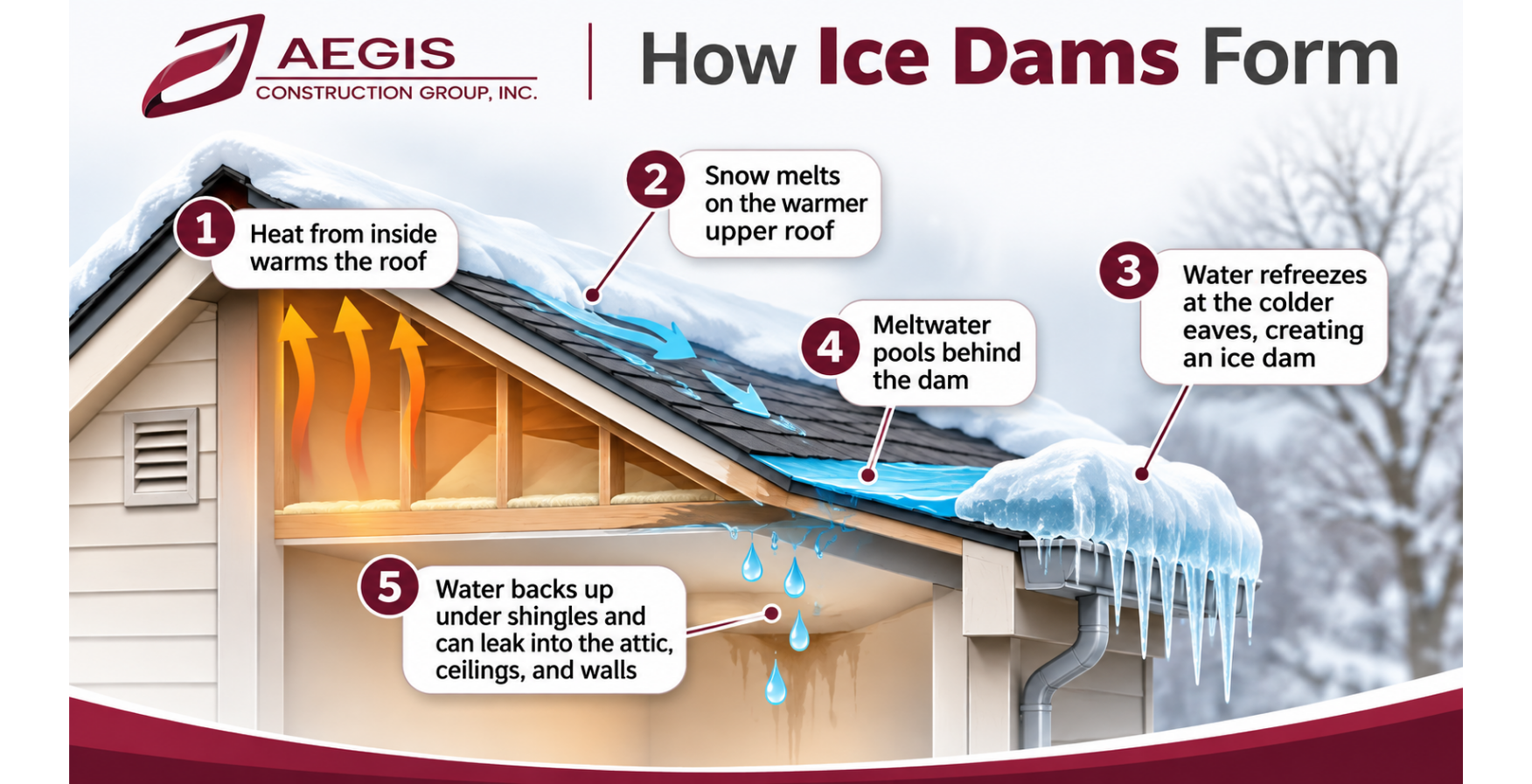
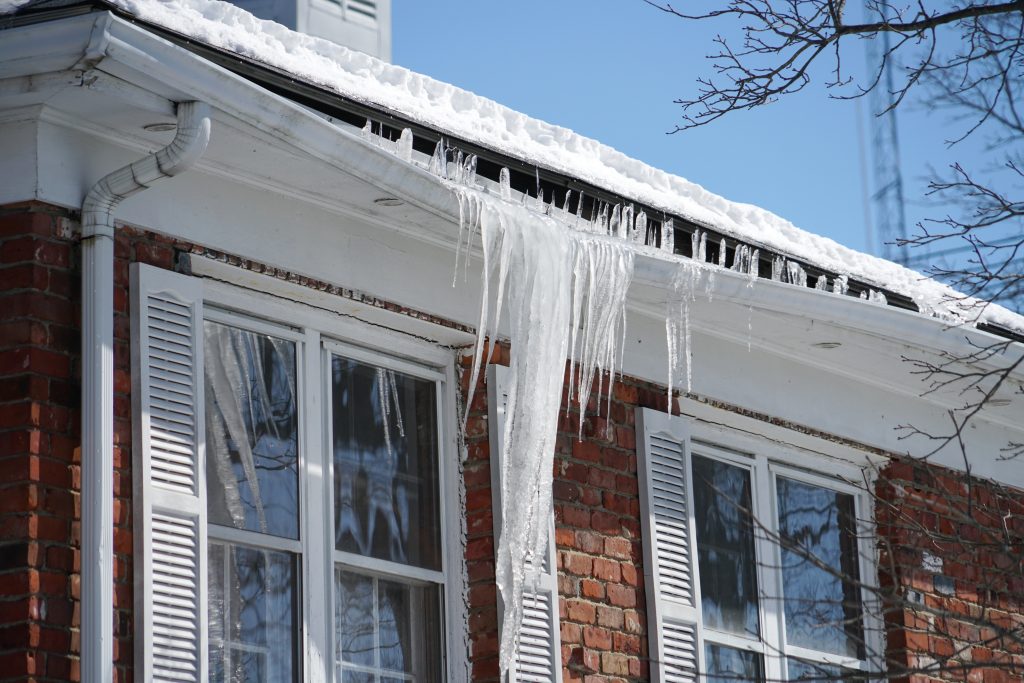
An ice dam is a ridge of ice that forms along the roof edge when snow melts on a warm upper roof and refreezes at the colder eaves. The ridge blocks drainage, so meltwater pools behind it and backs up under the shingles. From there it leaks into the attic, ceilings, and exterior walls, often days before a stain appears.
Freeze-Thaw Cycles
Water seeps into small gaps around flashing, nail heads, and shingle edges, then expands about 9 percent as it freezes. Every cycle opens the gap a little wider. A roof that was watertight in November can leak by March.
What Causes Ice Dams, and Why Are Chicago Homes So Prone to Them?
Ice dams form when heat escaping from the home warms the roof deck above freezing while the eaves stay below freezing. Snow melts on the warm section, runs down to the cold edge, and refreezes. As the ridge of ice grows, it blocks drainage and forces water beneath the shingles.
Chicago bungalows and Cape Cods are particularly susceptible. Their finished attics, low rooflines, and knee walls leave limited space for insulation and ventilation. Heat from the living space warms the roof deck and creates the uneven roof temperatures that lead to ice dams.
What Are the Signs of an Ice Dam?
The clearest sign of an ice dam is a thick ridge of ice along the roof edge with water trapped behind it. Other signs to watch for:
- Large icicles hanging from the gutters or forming behind them at the soffit
- Water stains on exterior walls below the eaves or above window frames
- Ceiling stains along outside walls, especially near the corners of a room
- Peeling paint or bubbling drywall near exterior walls
- Damp or matted insulation near the eaves in the attic
How Do You Remove an Ice Dam Safely?
The safe way to remove an ice dam is professional steam removal. Low-pressure steam cuts channels through the ice without stripping granules or tearing shingles the way hammers and pressure washers do.
Heat cables keep a drainage path open along eaves and valleys, which helps on roofs where the insulation is hard to fix, like cathedral ceilings and finished attics. However, they do nothing about the heat loss causing the melt, they cost money to run, and they can push the dam higher up the roof. Heat cables work best alongside insulation and ventilation fixes, not as a replacement for them.
How Do You Stop Ice Dams From Coming Back?
Ice dams stop forming when the whole roof deck stays cold, so snow melts evenly instead of refreezing at the eaves. That comes down to sealing attic air leaks, adding insulation, and balancing attic ventilation, with an ice barrier at the eaves during any replacement. For the full step-by-step process, see our guide on how to prevent ice dams.
How Much Snow Can a Roof Hold?
How much snow a roof can hold depends on weight, not depth. According to FEMA’s Snow Load Safety Guide, one foot of snow can weigh as little as 3 pounds per square foot when dry or more than 20 pounds per square foot when wet.
| Type | Approximate weight per foot of depth (lb per sq ft) |
|---|---|
| Light, dry snow | 3 |
| Wet, heavy snow | 21 |
| Ice | About 57 (roughly 5 per inch) |
Local building codes set the snow weight a roof must be designed for, and those numbers are rising in the suburbs. Chicago still uses a design ground snow load of 25 pounds per square foot under the Chicago Construction Codes. Oak Park raised its residential figure to 36.4 pounds per square foot under its 2026 permit submittal guide, and Streamwood requires 35 pounds per square foot.
The higher suburban numbers come from the 2024 International Codes, which adopt updated national snow load maps (ASCE 7-22) with site-specific values instead of one flat regional figure. That matters for older homes: a house built when 25 psf was the standard was not designed for the loads newer codes now assume. Engineers also convert ground snow load into a roof load based on pitch, exposure, and drifting, so these figures are not a hard limit for your house.
As a rough guide, start paying attention at a foot or more of wet snow or a few inches of solid ice. Older homes, additions, and low-slope sections have the least margin.
Does Your Roof Type Change the Risk?
Yes. Your roof’s material and pitch both affect how it handles snow and ice. Some materials are more vulnerable to cold-weather damage, while certain designs hold snow or develop drainage problems.
- Asphalt shingles: Older shingles become brittle in freezing temperatures. Ice can scrape away protective granules, and repeated freeze-thaw cycles loosen shingle edges and open paths for water.
- Metal roofing: Metal roofs shed snow quickly, sometimes in large, sudden slides. Snow guards help keep heavy accumulations from sliding onto entryways, driveways, and walkways.
- Flat and low-slope roofs: These surfaces don’t shed snow easily, so heavy accumulation lingers. Porch roofs, additions, and garages are especially vulnerable to excess weight and standing water when drains freeze or clog.
What Are the Signs Your Roof Was Damaged by Snow and Ice?
The most common signs of winter roof damage are ceiling stains, missing or curled shingles, and sagging gutters. Many problems only show up as temperatures rise or water works its way indoors, so check both outside and inside.
Signs You Can Spot From the Ground
Walk the perimeter with binoculars and look for:
- Missing, cracked, or curled shingles, or shingle pieces in the yard
- Gutters that sag or pull away from the fascia
- Bent or separated flashing around chimneys, vents, and skylights
- A roofline that dips where it used to run straight
Signs Inside the Home and Attic
- Brown or yellow stains on ceilings and upper walls
- Frost on the underside of the roof deck
- Damp or matted insulation
- Doors and windows that suddenly stick, or new cracks in drywall
Is It an Emergency? Winter Roof Damage Triage
A sagging roofline, cracking sounds, or water dripping inside need help now. Most other winter damage can wait a few days for a scheduled inspection.
| Sign | Urgency | What to Do |
|---|---|---|
| Sagging roofline, popping or cracking sounds, doors that suddenly stick | Now | Get everyone out and call a professional |
| Water dripping inside | Now | Catch the water, move valuables, call for emergency service |
| Ice dam, heavy icicles, or a dry ceiling stain | Within days | Schedule an inspection |
| Missing shingles, loose gutters or flashing | Within days | Book a repair before the next storm |
| Light granule loss or a small stain that has not grown | Before next winter | Monitor it and fix it in spring or fall |
Water coming in, or a roof that looks wrong? Aegis Construction Group offers 24/7 emergency response across Chicagoland area. Call (773) 812-3447.
Should You Remove Snow and Ice From Your Roof?
No, you should not shovel your roof. FEMA’s guide warns that removing roof snow is often more dangerous than leaving it, for both the person and the roof.
- Do: Use a roof rake from the ground to clear the lower three to four feet after a heavy snowfall. Leave a thin layer so the rake never scrapes the shingles.
- Don’t: Chip at ice, spread rock salt, pressure wash, or climb onto the roof.
If an ice dam has already formed, professional steam removal is the safe option.
Does Homeowners Insurance Cover Snow and Ice Roof Damage?
Often, if the damage was sudden. Most standard policies cover a sudden event, such as a collapse under the weight of snow or a leak caused by an ice dam. They usually exclude gradual damage such as a worn-out roof, slow seepage, or maintenance that was put off.
Interior water damage from an ice dam is typically treated differently from the cost of removing the ice itself, which many policies do not pay for. Check your policy or ask your agent before you assume either way.
Before you file, gather:
- Photos and video of the damage, inside and out
- The storm date and the date you first noticed a problem
- Receipts for tarping or other temporary repairs
- A written inspection report from a licensed roofer
Aegis inspects the roof for free, documents what we find for your claim, and can meet with your adjuster. See our storm damage page for more about how the process works.
How Do You Prepare Your Roof for a Chicago Winter?
The best winter prep is a fall inspection, clean gutters, and a well-sealed attic, all done before the first hard freeze.
- Fall inspection: Book it in September or October, while shingles can still seal after a repair.
- Gutter cleaning: Clear gutters and downspouts once the leaves are down so meltwater has somewhere to go.
- Attic check: Look for gaps around recessed lights, plumbing stacks, and the attic hatch, and confirm soffit vents are not blocked by insulation.
- Ice barrier: If you are planning a replacement, confirm the bid includes an ice and water barrier at the eaves.
Can You Repair or Replace a Roof in Winter?
Yes, you can replace a roof in winter, with a few adjustments. Asphalt shingles depend on a heat-activated adhesive strip, and most manufacturers recommend installing above roughly 40°F so the strip seals on its own. In colder weather, crews hand-seal each shingle with roofing cement and handle bundles carefully, because cold shingles crack more easily.
Repairs rarely need to wait. A leak, missing shingles, or failed flashing can be fixed on a dry day, and emergency tarping keeps water out until then. Full replacements get scheduled around the forecast. If the roof is leaking now, waiting for spring usually costs more than a winter roof repair.
Get a Free Ice Dam Inspection in Chicago
Snow and ice do their damage quietly, and a problem caught in January costs less than one discovered in April. Aegis Construction Group has served Chicagoland since 2015 from offices in Villa Park and Elmhurst. We offer free roof inspections, ice dam assessments, honest recommendations, and help with insurance claims.
Call (773) 812-3447 or schedule your free inspection today.
Snow, Ice, and Ice Dam FAQs
Can snow on a roof cause leaks?
Yes. Snow itself is not the problem, but when it melts and refreezes at the eaves it forms an ice dam. Water backs up under the shingles and leaks into the attic and ceilings.
Are icicles on my gutters a bad sign?
Small icicles are normal. Large ones, or a thick ridge of ice behind them, usually mean heat is escaping from the attic and an ice dam is forming.
Do gutters cause ice dams?
No. Heat escaping from the attic causes ice dams. Clogged gutters can make them worse by holding ice and water at the roof edge, but clean gutters alone will not prevent them.
How much does ice dam removal cost?
The cost depends on the length of the dam, roof access, and how thick the ice is. Removal is a short-term fix, so ask about air sealing and insulation to stop the dams from coming back.
Does homeowners’ insurance cover ice dam damage?
Often, yes, for sudden interior water damage caused by an ice dam. Many policies do not pay to remove the ice itself, and they usually exclude damage from gradual leaks or poor maintenance. Check your policy or ask your agent.
Is it safe to leave snow on my roof?
Usually, yes. Most roofs handle a normal snowfall without trouble. Rake the lower few feet after a heavy storm and call a roofer if you see sagging or hear cracking.
How do I know if my roof can handle heavy snow?
Watch the house, not just the snow depth. Sagging, popping sounds, sticking doors, and new drywall cracks are signs of stress. A fall inspection will flag weak spots ahead of time.
Will salt damage my shingles?
Yes. Rock salt corrodes metal flashing, gutters, and nails, can discolor shingles, and kills plants below the eaves. Use a roof rake or call for steam removal instead.
How fast can an ice dam cause damage?
Quickly. Once water backs up under the shingles, it can reach a ceiling within a day or two of a thaw. Some leaks stay hidden in the attic for weeks.
Should I get my roof inspected after winter?
Yes. A spring inspection catches lifted shingles, loose flashing, and gutter damage before spring rain turns them into leaks. Aegis offers free roof inspections across the Chicagoland area for residential and commercial properties.